Grill vs Griddle: Which One Do You Need?
The surface changes what you can cook and how it tastes. Here is the difference, in plain terms, and how to choose.
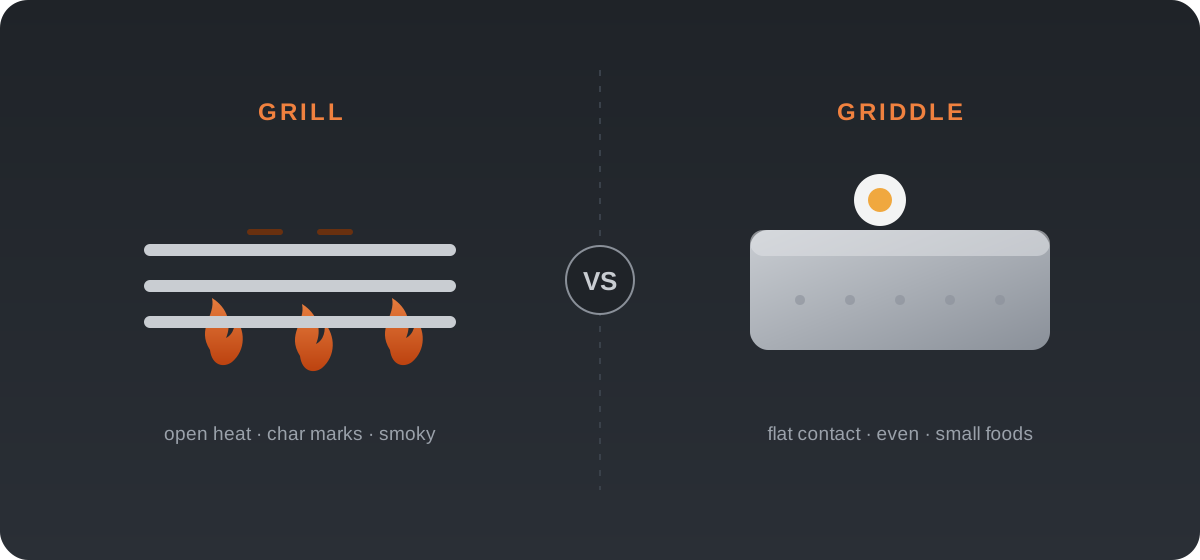
The basics
The core difference
| Consideration | Grill | Griddle |
|---|---|---|
| Cooking surface | Open grates or bars | Solid flat surface |
| Heat contact | Direct heat and flame reach the food; fat drips away | Heat concentrates on the surface; only food touching it cooks |
| Flavor | Char marks and a smoky, seared flavor | Even browning; food cooks in its own juices |
| Good for | Steaks, ribs, chops, sausages, vegetables on skewers | Pancakes, eggs, bacon, smash burgers, fried rice, small or chopped foods |
| Small foods | Can fall through grates | No falling through |
| Typical cleanup | Scrub grates; grease drips down | Scrape and wipe the flat surface |
When to choose a grill
- You want grill marks and a smoky, seared flavor.
- You cook steaks, bone-in cuts, ribs, or sausages.
- You like fat to drip away from the food.
- You have charcoal, or want to add smoke flavor.
Charcoal pairs with grilling for a smokier flavor. A gas grill does not add smoke on its own unless you use a smoker box or similar accessory.
When to choose a griddle
- You cook breakfast: eggs, pancakes, bacon, hash browns.
- You want to cook small or chopped foods that would fall through grates, such as diced vegetables or fried rice.
- You like smash burgers, which depend on full contact with a hot flat surface.
- You often cook for groups, since a flat surface lets you cook many items at once.
Can you have both?
Yes. There are three common ways:
- Two separate cookers: a grill and a griddle. Most flexible, but you pack and store two units.
- A grill with a griddle insert or add-on plate: you swap the surface when needed.
- A reversible plate: one plate with grates on one side and a flat surface on the other. You flip it to switch modes.
FoldSear uses the third approach: a reversible plate on a folding gas and charcoal grill. See how the reversible plate works or the full product.
How to decide
- Choose mostly grill if you cook steaks, ribs, and sausages and want char and smoke.
- Choose mostly griddle if you cook breakfast, small foods, or for large groups.
- Choose both if you camp, tailgate, or cook outdoors for varied meals but have limited space — see thecamping and RV guide and thebackyard and patio guide.
Cleanup and care, briefly
- Grill grates: brush off residue while warm, then wipe with oil to reduce sticking.
- Griddle surface: let it cool, scrape off food, wipe, and avoid abrasive cleaners.
- Non-stick plates: wash gently with mild detergent, avoid steel wool, and follow the manufacturer’s instructions.
These are general tips. Always follow the instructions for your specific product.
FAQ
Grill vs griddle questions
Is a griddle healthier than a grill?
There's no simple answer. Grilling lets fat drip away, while griddling cooks food in its own fat unless you drain it. Healthfulness mostly depends on what you cook and how much oil you use.
Can you cook burgers on a griddle?
Yes. Many people prefer griddles for smash burgers because the flat surface gives full contact.
Can you cook steak on a griddle?
Yes, for a pan-seared crust. For grill marks and a smokier flavor, a grill is the better fit.
Can I cook vegetables on a grill?
Yes, especially larger pieces or skewers. Small pieces may fall through grates, so use a basket or switch to a griddle.
What's easier to clean, a grill or a griddle?
It depends on the surface and how you maintain it. Flat surfaces are easier to scrape, while grates need brushing.
Is there a grill that does both?
Yes. Some models use a reversible plate or interchangeable surfaces.
Want grill marks and griddle breakfasts on one trip?
Last updated: October 24, 2026